Sunday, April 17, 2022

My Lord and My God

In many ways we are just like Thomas; aren’t we? We really don’t want to come by our faith second hand (John 20:19-31). Our parents taught us that something worth having was something worth working for. So we ask; is there really such a thing as “blind faith?” Blind faith does not encourage us to probe; it denies us the opportunity to question, to know what we believe intuitively, in our “core.” Blind faith requires minimal spiritual investment, and permits those inclined to cruise through their spiritual journey without the opportunity to really living life’s joy and danger. True faith requires knowing what we believe…beyond any doubt. So Thomas in refusing to say that he understood what he did not understand, or believe what he did not believe, exhibited an honesty that prompted his need to know. 

David Steindl-Rast wrote in Deeper than Words, "nothing is more significant in Jesus' parables than his appeal to "Common Sense." What a pity that the term has been abused to mean no more than sweet reasonableness or, worse, public opinion. Rightly understood, it means the deep awareness that we all have in Common and from which anything sensible must flow. We could even say that Common Sense is God's Holy Spirit in the human heart. And here Jesus differs from the prophets. They appealed to the authority of God standing behind them: 'Thus speaks the Lord God...' Jesus, in contrast, appeals to the authority of God in the hearts of the hearers." When we say the Word becomes flesh in us don't we mean that the "word" becomes an intuitive sense of who we are and what we believe?

Thomas wasn’t the faithless doubter. The so-called faithful disciples remained locked up in the upper room hiding in fear. Fear not doubt gets in the way of our letting the Holy Spirit take charge. Where did Thomas go while others were in hiding? What prompted him to return to his community? Was Thomas “working” at trying to know what he was asked to believe? Thomas wanted the experience of a deeper vision or sight. He was unwilling to blindly accept; it had to be real for him.

True faith is based on trust in God. True faith knows we can deepen our faith by asking critical questions of our traditions and our “inherited” belief propositions. We do this by leaving our comfort zones and living in new ways. Thomas’ encounter with the risen Lord challenges us to know what we believe; so for us as, with Thomas, we too can personally acclaim “My Lord and my God.”


Sunday, April 10, 2022

Why Easter matters


I suppose it’s only natural to think of Easter as a miracle; after all Christ’s rising from the dead is clearly within God’s realm. But calling Easter a miracle excuses us from having anything further to do with it, since a miracle is God’s doing. We believe that God’s incarnation in Jesus and Jesus’ death and resurrection were for our salvation and benefit, not God’s, thereby making Easter more a sacrament than a miracle. A sacrament, requires our participation for its existence.  God performs miracles but men celebrate sacraments.  God may work a miracle apart from men. However, man is essential to the presence of a sacrament. (John 20:1-9)

If Easter is to be a sacramental event, we must represent it for our brethren with our own flesh and blood.  Easter is sacramental every time one of us makes his life a source of comfort and hope for another.  Easter is sacramental when our words heal, when our hearts understand, when lesser values die in us for the sake of greater realities.

We are sacramental with Easter when men know us to be faithful.  We are sacramental with Easter when our fellow men see us suffer not for selfish advantage but for their redemption.  Easter is never more sacramental than when one man gives his life on behalf of another. Christians seek to make Easter sacramental in their lives by their memory of Jesus through their words and deeds.

John Calvin wrote that becoming Son of man with us, made us sons of God with him; that by his descent to earth, he has prepared an ascent to heaven for us; that by taking on out mortality, he has conferred his immortality upon us; that accepting our weakness, he has strengthened us by his power; that receiving our poverty unto himself, he has transferred our wealth to us; that taking the weight of our iniquity upon himself (which oppressed us), he has clothed us with his righteousness. (Kruger, The Shack Revisited, p. 197)

 Jesus became incarnate to not only teach us how to live our lives but to reside in Him through Jesus and lift us up into a life of communion, of participation in the very triune life of God. When we say “in him through him and with him” as we celebrate the Eucharist, we are reminded of our participation in his birth, death and resurrection.

(Adapted from Dawn without Darkness, Anthony Padovano, p78)

Monday, April 4, 2022

The Power of Love vs. The Love of Power


Every year the Roman army would come marching into Palestine during Passover. It was Pilate in the time of Jesus, who riding a white stallion, led the parade as a symbol of Rome’s dominance and oppression. It was a reminder to “nobodies” not to cause trouble during the Passover. So what does Jesus do? In a seemingly mocking parody, he rides a donkey (Luke 19:28-40), a lowly beast of burden in the opposite direction and enters through the gate from which Pilate exited. While Pilate needed a whole legion to demonstrate his importance and control, Jesus’ “power” was rooted in relationships and the everlasting love of God and in God’s desires for the good of the world and all its creatures. It was the power of love vs. the love of power on parade.

The gospel writers tell us that this event was not accidental. Jesus planned it ahead of time. He knew what he was doing and he knew he was risking the wrath of Rome by provoking the authorities. And eventually they caught up with him.

God did not plan Jesus’ death. God did not desire it. God did not need it for God’s salvation of the world and all its creatures to work out. So then, why the cross?

The Cross was used by the Romans to not only destroy the identity of the one who was crucified, but to erase his mission and send a warning to any of his followers. Ironically reviled as an image, the cross became and endured as a central symbol for our faith…a symbol of a nobody who is resurrected. No one would expect a nobody to be resurrected.

Contrary to some beliefs, Jesus was not ransomed for us, but rather, he takes our place, not for our sins, but for the trials of our human journey. Jesus resurrection fulfills the promise of our resurrection as our souls shed our mortal vessels and we are raised from death with Christ.

“It is amazing how a caterpillar spins about itself a hiding place from which it emerges and takes flight as a butterfly with delicate, iridescent wings. Similarly, Christ lived as a human being who freely entered into the hiding place of death to emerge, deathless, filled with light and life, utterly transformed. Our faith proclaims that in following Christ we experience the same thing: “Therefore if any person is in Christ, they are a new creature; the old things have passed away; behold, new things have come (2 Corinthians 5:17).” (Richard Rohr, Dying Before You Die,’ Rohr Meditations, CAC, 4-3-19)

We know and have known people like Gandhi, Martin Luther King and Rosa Parks, who at the very least put themselves at risk for the sake of others. This exchange is God standing with us as we face our reality and its dangers. God is in the midst of our human experience. Could we not think about the Russian invasion of the Ukraine in the same light? Did Pilate expect the crowd's reaction to the masses as they welcomed Jesus entering the opposite gate on a lowly colt? Did Putin underestimate the power of Love of the people for each other and their homeland besting the love of power? Could Putin  even understand it?

The cross reminds us that our world is still a “risky” place, and that much will be asked of us. Yet it reminds us that death has no power over us because we live in the light of the resurrection of a nobody who was raised up as will we. The cross reminds us to stand up for those who need to be rescued and to stand with those who work for the common good even when it seems to be hopeless or dangerous. We can live in a time of trouble with joy.

Jesus challenged the love of power and lived for the power of love. Jesus was offering a different vision of how things could be, Palm Sunday asks us: which vision of power will rule our lives? To which kingdom will we belong? Which parade will we join? (Adapted from Parades and Crosses, Holy Textures, George Hermanson) 

Sunday, March 27, 2022

"He cannot be the Messiah, can he?"


The character to whom we are introduced in this week's text is a Samaritan woman (John 4:5-42), a religious and political outsider, despised by the Judeans in Jesus’ time. The split between Samaritan Israelites and Judean-led Israelites still exists to this day. Samaritans had descended from tribes primarily residing in what is today Iraq and were not considered Jews in the pure sense by Judeans of Israel. 

The Samaritan woman meets Jesus alone at the well at noon. As if their encounter was not strange enough, the Samaritan moves outside of her social and religious tradition and engages Jesus in an in-depth conversation during which she quickly reminds him as to how his being a Jew and she a Samaritan, separates them. Yet, while at Jacob's well she also reminds him that they are connected though their common ancestor, Jacob.  

Somewhat out of character, Jesus tells the woman who he is as he reveals his “name,” I am he. How is it that this woman who meets Jesus briefly, dares to “wonder out loud” if he is the Messiah, while his apostles, still not quite convinced, continue to safely address him as teacher, “rabbi?” 

This story underscores Jesus’ love for what society characterizes as outsiders. The Samaritan woman at the well immediately recognizes the societal barriers and boundaries that keeps woman and especially a Samaritan woman in her place; yet she is willing to challenge Jesus' authority over the ancestors of their faith and while she is not certain that Jesus is the Christ she does not let that stop her from dropping everything, leaving her water jar behind and returning to her community and summoning them to meet Jesus "...and see a man who told me everything I have ever done! He cannot be the Messiah, can he?" They left the city and were on their way to him.”

The woman at the well shows us that faith is about an ongoing dialogue, growth and change. It is not about having all the answers. If  we are content with our faith just the way it is and are comfortable with our tried and true convictions, we may be missing an  opportunity for growth and transformation, and as such, lack the confidence to be able to ask others to "come and see" as the Samaritan woman did.

Another issue, perhaps for another discussion and another time, has to do with organized religions’ pronouncements on women and sexuality. At no time does Jesus condemn or judge her as society and organized religions have. Where did these rules come from? Shouldn’t we finally rise above phony moralism and misplaced misogyny that has characterized so much of Judeo-Christian theology? This is really a story about the transforming power of love and not about a story about a woman who like us, is no less human. After all, Jesus received the Cup from this “scandalous” woman, and she shares it with us in her joy at being loved. 

Monday, March 21, 2022

The Love That Surpasses All Understanding


The Prodigal Son, is among the most recognized parables in the New Testament, ( Luke 15:1-3,11b-32). While there are several important themes for us to consider in the reading, perhaps the most prevalent focuses on the father and the so-called “faithful son.” Paradoxically, the prodigal son is a secondary character in the story with regard to Jesus’ purpose in its telling.

The father characterized in the story represents an individual whose unconditional love seems to exceed the “normal” bounds of human ability and understanding. It’s hard to imagine a typical father or human being for that matter, who is capable of acting with such selfless compassion.

On the other hand, the reaction and behavior of the elder brother, who remains behind and steadfastly adheres to his father’s will in performing his day to day chores, seems all too human in his reaction to the father’s behavior. He finds that he cannot or is unwilling to rejoice in the return of his wayward brother.

 In this story Jesus reveals that the love of God surpasses all understanding and exists in a dimension beyond anything known to man. That love is evidenced in the scene in which the father rushes out to greet the Prodigal without and does not inquire into the son's derelict behavior or his intention to repent. The father merely rejoices in his return and in his honor, orders a feast celebrating his homecoming.

But the elder son, who professes to be more worthy of the father’s love is angry and resentful. After all wasn’t he the more faithful and dutiful son who quietly without fanfare went about his father’s business day in and day out?

So, to whom do we relate…the father; the elder son, or the Prodigal? What do you think the reaction of the community to the father’s behavior would be?

"Almost all religions and cultures  believe that sin and evil are to be punished and that retribution is to be demanded of the sinner in this world—and usually the next world, too. Such retributive justice is a dualistic system of reward and punishment, good guys and bad guys, and makes perfect sense to the ego…Mere counting and ledger-keeping is not the way of the God. Our best self wants to restore relationships, and not just blame or punish. The trouble is that we have defined God as ‘punisher in chief’ instead of Healer, Forgiver, and Reconciler and so the retribution model was legitimized down through the ages…On the other hand, the aim of restorative justice is to return the person to a useful position in the community. Thus, there can be healing on both sides. Such justice is a mystery that only makes sense to the soul…and yet the term restorative justice has only entered our vocabulary recently. How can we deny that there is an evolution of consciousness, even consciousness of where the Gospel is leading us?” (Richard Rohr, Restorative Justice, Center for Action and Contemplation. 6/12/18)


Monday, March 14, 2022

Psychology of Fear Vs Spirituality of Hope


It’s terribly hard work to persuade people to hope. Especially in bleak times, but even in good times, we hide our broken hearts, failures, losses, believing in the power of evil and not wanting to be hurt again.

Lent is a growing season, an aspirational journey, and a walk through the valley of the shadow of death. Hope draws us on.  Jesus, preaching hope on the road, urges people to work for the vision of God, for a new world. But he runs into our resistance everywhere.

Jesus reminded them about another terrible situation: the fall of the Tower of Siloam, a remnant of the old Temple, a place where men who didn’t like Roman rule worshiped in protest against the great Temple where Pilate and Herod held sway. Most folks blamed Pilate for the Tower’s fall. Eighteen people died in there. Do you think they were worse than all the others in Jerusalem and do you think their suffering means they were worse sinners than anyone else? Jesus asked. 
We have that deep fear in us when trouble comes – oh God, oh God, why are we being punished – when pain comes, we do not feel held in God’s love, but caught in God’s anger.

When the Pilates of this world show us their cruelty, we are intimidated by the power of their hate. Even though we know they are evil, even though we know hope is divine, yet we are more impressed by their evil than by God’s good. 
Hope gives birth to life. Hope creates, using imagination and playfulness and time. The thing about hope is, it takes time.

Hope does not create in response to pressure, or the insistence of the clock saying Hurry up! We’re out of time. Evil, on the other hand, screams Time’s Up! into unexpected moments, even into bright days. .’
Economist, Hugo Lindgren coined the expression, Pessimism Porn when he wrote about the joy of predicting and planning for economic collapse during the mortgage-based banking crisis in 2009 by some journalists.

Merriam-Webster defines pornography as the depiction of acts in a sensational manner so as to arouse a quick intense emotional reaction

Like real porn, the economic variety gives you the illusion of control, and similarly it only leaves you hungry for more. But econo-porn also feeds a powerful sense of intellectual vanity. You walk the streets feeling superior to all these heedless knaves who have no clue what’s coming down the pike. By making yourself miserable about the frightful hell that awaits us, you feel better. Pessimism can be bliss too. Pessimism Porn: A Soft spot for Hard Times, Hugo Lindgren, New York February 9, 2009

Commenting on the 2009 meltdown, NYT Journalist. David Brooks writes, ‘People are motivated to make wise choices more by hope and opportunity than by fear, cynicism, hatred and despair. He praises leaders who never appeal to those passions, which bar the door to hope and opportunity.

At this point in time the cataclysmic events of today’s world precipitated by Putin’s invasion of Ukraine is typified in our reading (Luke 13:1-9). We are consumed with the fact that we are virtually a hairs breath from a global war. The contrast between fear, pessimism and hope is all around us as we are immersed in these emotions. The way in which our world leaders have responded can be characterized as either followers of Pilate or Jesus. And what about the news media repeatedly running video clips emphasizing the graphically horrific scenes of massacre in the Ukraine, titillating viewers to want more, distracting them from the real news. How many times did the media need to show the despicable scene in which a police officer pressed his knee to George Floyd’s neck killing him? Do we need to see the January 6, 2021 siege of the Capitol to know that it was an act of treason? And does a reporter need to stand in freezing snow up to his or her knees to convince us it’s snowing? Yet, every time the scenes are shown, we look and are hungry for more

For us the personal tragedy of the Ukrainian people is just a minor inconvenience characterized by the rising price of gasoline and to some extent, inflation, although economists will tell us that began long before Russia invaded Ukraine. Does the response of our world leaders engender hope or instill fear?

Jesus never appealed to those passions, not even as he entered Jerusalem, not even on Good Friday. Along the road of his life, Jesus dispels fear wherever he encounters it, and he challenges our cynicism and despair, urging us to give hatred no room.

When Jesus sees people knotted up and tense at the mention of the murdered Galileans and the Tower of Siloam, he responds with a playful tale, creating a space in time where hope can rise:

A man comes to check on his fig tree (and everyone knows the fig tree is Israel’s symbol, the tree that lives for centuries, the tree that has many fruiting times each year, the tree that gives fruit and oil and shade and holds onto life.) But this fig tree has no fruit. Impatiently the man says to the gardener, ‘It’s been three years, and no fruit! Cut it down.’ But the gardener says, ‘Give it another year, and I’ll fertilize it and hoe around it, and then come and see.’

And who would this patient gardener be, if not God? And what is this tale about, if it is not about growing hope? Preparing ourselves for Easter requires giving up our addiction to a dystopian view of our lives. Easter requires us to hoe around our own roots, to feed our hope and not our pessimism, and to bide our time, till what is fruitful in us can emerge and be seen.

(Adapted from Nancy Rockwell, “The Bite of the Apple,” February 21, 2016.)

Sunday, March 6, 2022


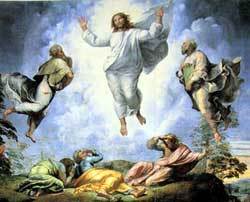
Do you remember when you first felt an "undeniable prompt" breaking through conscious thought that called you to pursue a goal or an activity, something out of the blue? And when we did hear and respond to the prompt were we aware that it was God's voice? The term "a calling" is common among clergy but we don’t necessarily consider that we’re called to a career or vocation or volunteering. But, why not? I raise this question because I think that this is part of the Transfiguration story (Luke 9:28b-36) that gets overlooked.  Let’s face it, we understandably focus on Jesus’ transformation, after all the blazing face, and dazzling white clothes are pretty awesome but they are distracting and get in the way of the Gospel's message for us. But I think that the event may also signal Peter's transformation and as our representative at the scene, a metaphor for ours.

Here we see Peter falling all over himself looking for something to do when a voice from heaven literally interrupts him, and in essence says, "Would you please shut up, and just listen to him!" In fairness to Peter, the whole experience is kind of terrifying as he falls to the ground, likely covering his ears and shielding his eyes. And then it's over... the voice, the light, the "saints" of the past...nothing is left except Jesus, who reaches out to Peter, James and John, and calms their fears, and asks them to get up.

 I suspect for a while everything seemed clear to Peter and made sense. But we know it didn't last very long. On the way down the mountain Jesus had to remind Peter of his impending death and destiny. But Peter struggles to listen, to follow, and once again he will fail. I know I would have also wondered minutes or hours later...was I dreaming? Did I imagine what just happened? Did I hit my head when I fell? Chances are
 Peter would look back on this day forever and recall those words, "listen to him!" If nothing else made sense, he would ask where did those words come from? Our egos need to interpret what we hear or know to keep our "understanding" within the confines of human experience, unwilling to acknowledge the active, constant presence of God in our lives. Why do we constantly have to translate for God?

Perhaps Peter's transformation begins when he repeatedly fails, falls, and is lifted up again and realizes that above and beyond everything else, he is called to listen. Isn’t this the pattern that shapes our lives? We try our best and sometimes succeed and sometimes fail. We have moments of lucid insight and moments of denial. We fall down in fear and are raised up again.

 We are called to listen, to discern God's will and in this way be transformed.  This story is as much about Peter and Jesus as it is about us. We are called  to listen for His voice in the subtle prompts that move our lives, however it may be "communicated." It's likely His voice will not be as dramatic as the One Peter heard on Mount Tabor but we will recognize it if we don't allow our egos to interpret it for us.

“There have been quite a few times when I have felt the winds of God’s grace in the sails of my small boat. Sometimes these graces have moved me in pleasant and sunlit directions. At other times the requested acts of love were born in the darkness of struggle and suffering. There have been spring times and there have been long cold winters of struggle for survival. God has come to me at times with the purest kindness, at times with the most affirming encouragement, and at other times with bold frightening challenges. I think that all of us have to watch and pray, to be ready to say “yes” when God’s language is concrete and his request is specific-“yes” in the sunlit spring times and “yes’ in the darkness of winter nights.” (John Powell, S.J., The Christian Vision, The Truth That Sets Us Free, p147)