Monday, March 21, 2022

The Love That Surpasses All Understanding


The Prodigal Son, is among the most recognized parables in the New Testament, ( Luke 15:1-3,11b-32). While there are several important themes for us to consider in the reading, perhaps the most prevalent focuses on the father and the so-called “faithful son.” Paradoxically, the prodigal son is a secondary character in the story with regard to Jesus’ purpose in its telling.

The father characterized in the story represents an individual whose unconditional love seems to exceed the “normal” bounds of human ability and understanding. It’s hard to imagine a typical father or human being for that matter, who is capable of acting with such selfless compassion.

On the other hand, the reaction and behavior of the elder brother, who remains behind and steadfastly adheres to his father’s will in performing his day to day chores, seems all too human in his reaction to the father’s behavior. He finds that he cannot or is unwilling to rejoice in the return of his wayward brother.

 In this story Jesus reveals that the love of God surpasses all understanding and exists in a dimension beyond anything known to man. That love is evidenced in the scene in which the father rushes out to greet the Prodigal without and does not inquire into the son's derelict behavior or his intention to repent. The father merely rejoices in his return and in his honor, orders a feast celebrating his homecoming.

But the elder son, who professes to be more worthy of the father’s love is angry and resentful. After all wasn’t he the more faithful and dutiful son who quietly without fanfare went about his father’s business day in and day out?

So, to whom do we relate…the father; the elder son, or the Prodigal? What do you think the reaction of the community to the father’s behavior would be?

"Almost all religions and cultures  believe that sin and evil are to be punished and that retribution is to be demanded of the sinner in this world—and usually the next world, too. Such retributive justice is a dualistic system of reward and punishment, good guys and bad guys, and makes perfect sense to the ego…Mere counting and ledger-keeping is not the way of the God. Our best self wants to restore relationships, and not just blame or punish. The trouble is that we have defined God as ‘punisher in chief’ instead of Healer, Forgiver, and Reconciler and so the retribution model was legitimized down through the ages…On the other hand, the aim of restorative justice is to return the person to a useful position in the community. Thus, there can be healing on both sides. Such justice is a mystery that only makes sense to the soul…and yet the term restorative justice has only entered our vocabulary recently. How can we deny that there is an evolution of consciousness, even consciousness of where the Gospel is leading us?” (Richard Rohr, Restorative Justice, Center for Action and Contemplation. 6/12/18)


Monday, March 14, 2022

Psychology of Fear Vs Spirituality of Hope


It’s terribly hard work to persuade people to hope. Especially in bleak times, but even in good times, we hide our broken hearts, failures, losses, believing in the power of evil and not wanting to be hurt again.

Lent is a growing season, an aspirational journey, and a walk through the valley of the shadow of death. Hope draws us on.  Jesus, preaching hope on the road, urges people to work for the vision of God, for a new world. But he runs into our resistance everywhere.

Jesus reminded them about another terrible situation: the fall of the Tower of Siloam, a remnant of the old Temple, a place where men who didn’t like Roman rule worshiped in protest against the great Temple where Pilate and Herod held sway. Most folks blamed Pilate for the Tower’s fall. Eighteen people died in there. Do you think they were worse than all the others in Jerusalem and do you think their suffering means they were worse sinners than anyone else? Jesus asked. 
We have that deep fear in us when trouble comes – oh God, oh God, why are we being punished – when pain comes, we do not feel held in God’s love, but caught in God’s anger.

When the Pilates of this world show us their cruelty, we are intimidated by the power of their hate. Even though we know they are evil, even though we know hope is divine, yet we are more impressed by their evil than by God’s good. 
Hope gives birth to life. Hope creates, using imagination and playfulness and time. The thing about hope is, it takes time.

Hope does not create in response to pressure, or the insistence of the clock saying Hurry up! We’re out of time. Evil, on the other hand, screams Time’s Up! into unexpected moments, even into bright days. .’
Economist, Hugo Lindgren coined the expression, Pessimism Porn when he wrote about the joy of predicting and planning for economic collapse during the mortgage-based banking crisis in 2009 by some journalists.

Merriam-Webster defines pornography as the depiction of acts in a sensational manner so as to arouse a quick intense emotional reaction

Like real porn, the economic variety gives you the illusion of control, and similarly it only leaves you hungry for more. But econo-porn also feeds a powerful sense of intellectual vanity. You walk the streets feeling superior to all these heedless knaves who have no clue what’s coming down the pike. By making yourself miserable about the frightful hell that awaits us, you feel better. Pessimism can be bliss too. Pessimism Porn: A Soft spot for Hard Times, Hugo Lindgren, New York February 9, 2009

Commenting on the 2009 meltdown, NYT Journalist. David Brooks writes, ‘People are motivated to make wise choices more by hope and opportunity than by fear, cynicism, hatred and despair. He praises leaders who never appeal to those passions, which bar the door to hope and opportunity.

At this point in time the cataclysmic events of today’s world precipitated by Putin’s invasion of Ukraine is typified in our reading (Luke 13:1-9). We are consumed with the fact that we are virtually a hairs breath from a global war. The contrast between fear, pessimism and hope is all around us as we are immersed in these emotions. The way in which our world leaders have responded can be characterized as either followers of Pilate or Jesus. And what about the news media repeatedly running video clips emphasizing the graphically horrific scenes of massacre in the Ukraine, titillating viewers to want more, distracting them from the real news. How many times did the media need to show the despicable scene in which a police officer pressed his knee to George Floyd’s neck killing him? Do we need to see the January 6, 2021 siege of the Capitol to know that it was an act of treason? And does a reporter need to stand in freezing snow up to his or her knees to convince us it’s snowing? Yet, every time the scenes are shown, we look and are hungry for more

For us the personal tragedy of the Ukrainian people is just a minor inconvenience characterized by the rising price of gasoline and to some extent, inflation, although economists will tell us that began long before Russia invaded Ukraine. Does the response of our world leaders engender hope or instill fear?

Jesus never appealed to those passions, not even as he entered Jerusalem, not even on Good Friday. Along the road of his life, Jesus dispels fear wherever he encounters it, and he challenges our cynicism and despair, urging us to give hatred no room.

When Jesus sees people knotted up and tense at the mention of the murdered Galileans and the Tower of Siloam, he responds with a playful tale, creating a space in time where hope can rise:

A man comes to check on his fig tree (and everyone knows the fig tree is Israel’s symbol, the tree that lives for centuries, the tree that has many fruiting times each year, the tree that gives fruit and oil and shade and holds onto life.) But this fig tree has no fruit. Impatiently the man says to the gardener, ‘It’s been three years, and no fruit! Cut it down.’ But the gardener says, ‘Give it another year, and I’ll fertilize it and hoe around it, and then come and see.’

And who would this patient gardener be, if not God? And what is this tale about, if it is not about growing hope? Preparing ourselves for Easter requires giving up our addiction to a dystopian view of our lives. Easter requires us to hoe around our own roots, to feed our hope and not our pessimism, and to bide our time, till what is fruitful in us can emerge and be seen.

(Adapted from Nancy Rockwell, “The Bite of the Apple,” February 21, 2016.)

Sunday, March 6, 2022


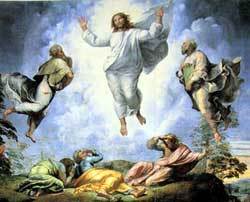
Do you remember when you first felt an "undeniable prompt" breaking through conscious thought that called you to pursue a goal or an activity, something out of the blue? And when we did hear and respond to the prompt were we aware that it was God's voice? The term "a calling" is common among clergy but we don’t necessarily consider that we’re called to a career or vocation or volunteering. But, why not? I raise this question because I think that this is part of the Transfiguration story (Luke 9:28b-36) that gets overlooked.  Let’s face it, we understandably focus on Jesus’ transformation, after all the blazing face, and dazzling white clothes are pretty awesome but they are distracting and get in the way of the Gospel's message for us. But I think that the event may also signal Peter's transformation and as our representative at the scene, a metaphor for ours.

Here we see Peter falling all over himself looking for something to do when a voice from heaven literally interrupts him, and in essence says, "Would you please shut up, and just listen to him!" In fairness to Peter, the whole experience is kind of terrifying as he falls to the ground, likely covering his ears and shielding his eyes. And then it's over... the voice, the light, the "saints" of the past...nothing is left except Jesus, who reaches out to Peter, James and John, and calms their fears, and asks them to get up.

 I suspect for a while everything seemed clear to Peter and made sense. But we know it didn't last very long. On the way down the mountain Jesus had to remind Peter of his impending death and destiny. But Peter struggles to listen, to follow, and once again he will fail. I know I would have also wondered minutes or hours later...was I dreaming? Did I imagine what just happened? Did I hit my head when I fell? Chances are
 Peter would look back on this day forever and recall those words, "listen to him!" If nothing else made sense, he would ask where did those words come from? Our egos need to interpret what we hear or know to keep our "understanding" within the confines of human experience, unwilling to acknowledge the active, constant presence of God in our lives. Why do we constantly have to translate for God?

Perhaps Peter's transformation begins when he repeatedly fails, falls, and is lifted up again and realizes that above and beyond everything else, he is called to listen. Isn’t this the pattern that shapes our lives? We try our best and sometimes succeed and sometimes fail. We have moments of lucid insight and moments of denial. We fall down in fear and are raised up again.

 We are called to listen, to discern God's will and in this way be transformed.  This story is as much about Peter and Jesus as it is about us. We are called  to listen for His voice in the subtle prompts that move our lives, however it may be "communicated." It's likely His voice will not be as dramatic as the One Peter heard on Mount Tabor but we will recognize it if we don't allow our egos to interpret it for us.

“There have been quite a few times when I have felt the winds of God’s grace in the sails of my small boat. Sometimes these graces have moved me in pleasant and sunlit directions. At other times the requested acts of love were born in the darkness of struggle and suffering. There have been spring times and there have been long cold winters of struggle for survival. God has come to me at times with the purest kindness, at times with the most affirming encouragement, and at other times with bold frightening challenges. I think that all of us have to watch and pray, to be ready to say “yes” when God’s language is concrete and his request is specific-“yes” in the sunlit spring times and “yes’ in the darkness of winter nights.” (John Powell, S.J., The Christian Vision, The Truth That Sets Us Free, p147)


Sunday, February 27, 2022

Our Time In The Desert


There are questions we answer with our lips, and those we answer with our lives. Lent is an important part of our journey. Each step we take has been walked at one time in the gospels. We know that this our spiritual journey begins in the desert and leads us to the cross and to a tomb and “ends” with Easter, where our journey to God begins again. In our readings for this upcoming Sunday, Luke 4:1-13 , the first Sunday in Lent, we are told that “Jesus was led by the Spirit in the wilderness, where for forty days he was tempted by the devil.”  What do these temptations or tests mean to us in our lives today? 

I have been fortunate to have travelled fairly extensively in my life, both for business and pleasure. Admittedly travelling is one of my passions, although in recent years I am more selective about my destination with regard to the risk to benefit associated with where and why I am travelling. Is the payoff worth the sacrifice? 

Over the years I have observed that there are two types of journeymen. I would categorize these as being either tourists or travelers. The tourist travels through his journey in comfort, ensuring that his experiences are familiar and safe. He makes sure that he takes “his stuff” from back home with him. There are many vendors along the way who, for a price, would be willing to accommodate the tourist’s expectations and satisfy his needs, most of which are likely superficial and soon forgotten when he returns home armed with photos, souvenirs, and pleasant memories. 

On the other hand, a traveler is one whose goal is to enjoy the journey as part of a total experience in which the destination is just a part of a continuum. He travels to open his mind and spirit up to new experiences and perhaps into the unknown in the hope that something new will learned and be revealed. 

A few years ago, we decided to take a trip to Galapagos; our goal was to experience it as up close and personal as we could, requiring that we leave our “comfort zone” and all the attachments of our lives back home. In addition to there being no cell phones, internet or TV, our accommodations were acceptable but far from luxurious. While this was a far cry from the way we usually travel, it was one of the most enjoyable trips I’ve ever taken. We were living in the journey; completely absorbed by the experience and focused on the experience and unencumbered by distractions. 

Jesus’ time in the desert reminds me of our journey as a traveler not a tourist. We left our comfort zones and worldly distractions and became on with the trip. If our desire is to recognize the presence of God in all things and in us, we may have to look for Him in unfamiliar places. Like Jesus, we place ourselves in God’s hands and listen for his promptings and his will for us.

Monday, February 21, 2022

Compassion is a Verb


Sometimes, Jesus’ teachings don’t seem to make practical sense. When we hear things like love your enemies and do good to them, turn the other cheek when struck, give to anyone who asks, do to others as you would have them do to you, be merciful, stop judging, forgive, and give to others, we get a bit unsettled. After all, it’s okay for God to do all of these things, but does He really want us to do them, too? Many good-hearted Christians really draw the line with some of these ideals and say, “No way!” They even remark that if someone did something hurtful to someone they loved, they would have no reservations seeking severe retribution. 

There is still this persistent thinking, even among those who consider themselves Christian, that a violent action deserves a violent response. Somehow, we continue to justify this. Yet, it is most clearly against the very grain of the Gospel. Part of our difficulty has more to do with understanding God’s love. We wrongly think that sinful or hurtful actions and evil people somehow are seen as lesser in God’s eyes. They are not. God loves the sinner as much as He does the saint. And, both of these inclinations exist in every human being, even those who consider themselves holy. 

Both the capacity for good and the disposition toward evil exist in every one of us. Viktor Frankl has this to say when reflecting on the Holocaust: “Our generation is a realistic generation because we have learned what a human being really is. When all is said and done, man is that same creature who invented the gas-chambers of Auschwitz; but he is also that being who walked upright into those chambers with the prayer ‘Shema Yisrael’ on his lips.” If we believe in God, we have to act like God. Whether we like that idea is another issue. If we don’t then perhaps, we need to reconsider our faith and whether we really believe in Jesus Christ. We are made in the image of God, not the image of ourselves. (Luke 6:39-45) The Christian must, at all costs, leave resentment and the need for retaliation behind, lose defensiveness and bring into the mind and heart the realization of who we represent in this world. (Adapted from St. Benedict Church, Holmdel, NJ, February 20, 2022.)

Monday, February 14, 2022

Love your enemies...


The teachings of Jesus and the example set by Mahatma Gandhi were the models that inspired Martin Luther King Jr.'s practice of non-violence as a means of effective protest. Just as Jesus reinterpreted the biblical laws for the audience and culture of his day, King implemented modern practice their relevance for him and his contemporary audience. For King and others, Jesus' words were not meant to be taken literally as he understood their intent, and while not all Christians have followed his example, King replaced a natural inclination to retaliate with temperance and love.

Jesus’s intent in his own words were not to abandon God's Law handed down to Moses, but rather re-interpret them in light of contemporary realities. This did not lessen the challenge of ancient biblical texts for modern society as Jesus' own life was their incarnate fulfillment made relevant by his words and his behavior. (Luke 6:27-38)

It was common practice to retaliate for harm done whether intentional and unintentional. This was supported by Old Testament readings and by the ancient Babylonian Code of Hammurabi, "an eye for an eye." But Jesus admonishes followers not to oppose the evil doer violently but resist and “turn the other cheek.” Jesus alternative strategy was intended to overcome evil with good which had a paradoxical effect in that what was perceived as weakness, humiliated and shamed those in power. Many of us old enough to remember the reaction to Dr. King’s behavior by those “in power” who violently opposed him, recall how the oppressor who embodied the love of power was overcome by the power of love.

Loving unconditionally and forgiving one's enemy are not just models for our behavior but on a broader scale, representative of the perfection of God and his divine love. As such, Jesus provides an intriguing image to capture the meaning of this quality of God and one that God's followers should strive to emulate. As a tree provides shade for all who sit below, God provides for the just and the unjust, and so we must treat others without bias whether "good" or "evil.


Sunday, February 6, 2022

I learned the truth at seventeen


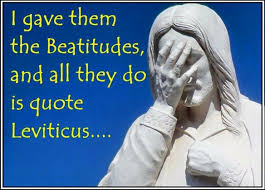
 How many of us were raised to think that the Beatitudes were an outline of character traits that we as Christians were called to embody? While in some ways this is true, here again we see Jesus turning everything in the world upside down.  Blessed are the poor in spirit; blessed are they who mourn; blessed are the meek. Really? Doesn’t this contradict those traits that usually characterize success? Jesus is saying that those who have no reason in this world for hope or joy are the ones for whom God’s Kingdom has been prepared? 

A few months ago we had an opportunity to celebrate my granddaughter's seventeenth birthday which prompted discussion of memorable birthday’s in our lives. As I listened to the reflections from others, I remember that seventeen was a year of betwixt and between; it was the best of times and worst of times. It was a care free time of adolescence in which the child in us had its way, but it also was a time of approaching “adulthood” with the world knocking and wanting answers that we were not always prepared to give. Some would say Can’t we just stay here a little while longer; do I have to be so ready to make like-altering decisions? Others could not wait to forge ahead. In both instances there is a learning curve and the care-free days of youth are turned upside down. This is a time to get serious about life, or is it. 

This introspective discussion prompted me to think about our Gospel (Luke 6:17, 20-26) and the eatitudes and how they run counter-intuitive to what we were been taught as society’s rules for successful living. Janis Ian and Jesus summed it up for me: 

To those of us who knew the pain,

Blessed are they who mourn,
Of valentines that never came,

Blessed are they who hunger and thirst,
And those whose names were never called,

Blessed are the poor in spirit,
When choosing sides for basketball,

Blessed are the meek
It was long ago and far away
the world was younger than today
when dreams were all they gave for free,

Blessed are you when they insult and persecute
to ugly duckling kids like me...

It isn’t all it seems At Seventeen. 

To me this is related song relates to Jesus’s ministry and the upside down world of God’s Kingdom vs our world. The laws of man and of the world have little to do with God’s. Over the past weeks we have read that man’s worldly expectations of power, wealth, fame, and happiness are not God’s. Jesus challenges our conventional wisdom that suggests that success, however we define it, or wealth or power equals happiness. He teaches that concern for losing those fleeting, superficial abstractions relate to a life of fear and competition which leads us to believe that we can only be happy by winning, and by beating someone else at the game. At seventeen we leave our childhood behind and prepare to enter the “grown up” world. At seventeen I learned the truth... It isn't all it seems, at seventeen. 

One of the reasons this upside-down approach to living appears to be so elusive is that it requires that we accept that we are vulnerable; we are human. We have to accept our basic vulnerability as humans in order to let go and embrace life as it is. Most of us find this quite difficult, if not downright impossible. It requires that we acknowledge our vulnerability—which is something most of us spend a lot of energy and effort trying to avoid. Our egos rule our self- image and take us to places that require us to want the props that support a façade that will eventually break. 

There is something about letting go of our obsession with getting what we want, and accepting what life brings us that opens up our ability to enjoy the goodness around us. This Jesus way enables us to relate to others with love and compassion. We begin looking at the world with the eyes of Jesus and live in God’s Kingdom in the here and now on earth as it is in heaven. At seventeen I learned the truth. Really?