Monday, January 24, 2022

The Fishers of Men

Yes I know it’s February and Christmas is a distant memory, and while I love the holiday, I’m glad it’s all behind us and we are well into the New Year and closing in on Lent. So then why do I choose to use what many consider a Christmas classic, It’s a Wonderful Life as a segue to our gospel, (Luke 5:1-5)? In this reading we are reminded that Jesus is not talking to what we might consider leaders in the community…the people with power, money and authority. Jesus is talking to the common man and in words they will understand. He tells them that as fishers of men, they possess the ability to transform the world.

So what does this have to do with the movie? How well we have come to know the story of George Bailey, a struggling businessman whose dreams and aspirations are shattered as his life gets sidetracked by unintended consequences. I wonder how many of us can relate to unplanned events in our lives that have taken us far afield from our life’s plans. As we look back don’t we often wonder how different life would have been if unintended consequences had not intervened? The movie reminds us that everything that happens has consequences and that everyone in some way relates to one another.

There are two scenes in particular that reminds us that in some small way we are a force for change, although sometimes we don’t recognize it. In a discussion that George has with his father during dinner, the very evening of his father’s death, George condescendingly rejects any notion of following his father’s footsteps and take over the bank someday. His father tells him, you know, George, I feel that in a small way we are doing something important. Satisfying a fundamental urge for a man to want his own roof and walls and fireplace, and we’re helping him get those things in our shabby little office. And while not in his plan, George does follow in his father’s footsteps.


The other scene comes as George, a victim of unintended consequences and on the brink of despair, wonders if his life was all worth it. His “guardian angel,” Clarence shows and tells him that every man’s life touches so many other lives, and when he isn’t around he leaves an awful hole, doesn’t he?

We all know people who by their very presence have made us better persons just by being in our lives. How many, we wonder, have touched us without our or their knowledge. These are “Godly” people.

Truly Godly people are the ones who make a difference everywhere they go, although unintended consequences may prevent them from even knowing that they have. Somehow, they always seem to be in the right place at the right time and doing the very thing that is most needed at any given time. And the difference between Godly folks and everyone else, is that they try to live life as Jesus did by loving God the only way they can…by loving each other. We are not alone; we are not insignificant; we are loved, cared for and intended for wonderful purposes. It truly is a wonderful life.

Monday, January 17, 2022


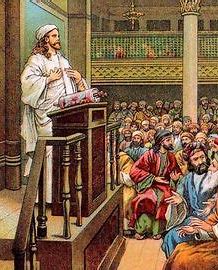
And so in Luke 4:14--21 the day arrives…the local boy who has been making quite a name for himself, comes home. He goes to the synagogue on the Sabbath. He reads from Isaiah. He speaks a few words. The crowd whispers its approval: "Mary and Joseph certainly raised a good son." They say. But suddenly the crowd is beginning to get uneasy as his readings continue. Could he be taking Isiah's prophecy too far as if he were the fulfillment of the prophecy. Did they hear correctly?

They’re aware of all the miracles he has performed before returning home. And many had gathered to see him “perform.” Why not a little razzle-dazzle for the home town folks? If Jesus would just do some healings or some other miracle, they would know that God's power was here and now, once and for all, and he would finally drive out the pagan Gentiles and their ungodly influences in the city. But Jesus performs no miracles in Nazareth, and in fact he goes out of his way to defy expected convention by reaching out to sinners, toll collectors and outcasts. So what started as an initially positive response among the assembled, leads to anger and hatred when his mission opens up to include the Gentiles. 

The essence of Jesus’ ministry is the love of God for all people. What is it that sparks this abrupt shift from awe to rage for the hearers of Jesus’ words? As for Jesus, it’s hard enough to live up to anticipated expectations. It’s harder still, of course, to meet up with unexpected rejection. There is a very human dimension to this whole story. When the hometown boy makes good, there are usually more than a few who resent his success. Why? As for us, there are all sorts of people in our lives who call us to compassion and justice. Some of them are very ordinary. What is it about the ordinary that’s so hard to see?

Monday, January 10, 2022

My Hour Has Not Yet Come


Of all the Gospels, the Wedding at Cana is unique to John’s and is the first of the evangelist’s seven signs.  John referred to Jesus’ “miracles” throughout his ministry as signs pointing to the Lord’s divinity. Yet, while the scene conjures up a beautiful image of Jesus as a young man accompanying his mother to a wedding feast, it reminds us that the mystery of God’s incarnation in Jesus, has as much to do with Jesus’ humanity as his divinity. That God could do miraculous things is easily understood. After all he is God. But that he could live fully human just like us with all our fears and joy, is still amazing. He is one of us… and that’s the point.

The exchange between Jesus and his mother is personally familiar and humorous. Mary, who John never calls by name, senses the embarrassment of the wedding hosts and advises Jesus that they have run out of wine. (Jesus’ might well have answered they should have hired a better wedding planner.) But without paying him any mind, Mother Mary tells the servants to do whatever he says.

I remember my mother encouraging me on the high diving board in Steeplechase pool in Coney Island: “Come on, you can do it! I know you can!” “But, Ma, I’m not ready yet, it’s too high and I’m scared.” “Don’t be afraid, I’m here, you can do it, I know your can do it.”

Or a time much later time in my life when in the throes of an ongoing job interview process I really wanted, my mother comes home with the telephone number of a “big shot executive” son of a friend who is expecting my call. “Ma, this is not how it’s done” I protested; “it’s embarrassing. You don’t get a job just because you work with someone’s mother.” Oblivious to my response, she replies “Never mind, just call him at 10:00 AM tomorrow; he’s expecting you.” 

I wonder what my mother or Mary saw in their sons at that moment. Why did my mother know that I could dive off the high board or that I could get the job of my dreams?  Mary had faith in her son and believed that such a miracle was possible? How did she know that this was his time? How did my mother know that I was ready and just needed a little push? 

And can we relate to the unspoken “dialogue” between Rosa Parks and Martin Luther King. In many ways the exchange between Mary and Jesus is somewhat reminiscent of that unspoken “dialogue,” characterized by Rosa’s refusing to yield her seat. Could this well-publicized event have provoked King, whose time he thought had not yet come to transform history. His time had come.

It is more than coincidence that Jesus’ mother surrounds his earthly ministry. She is there at his birth, the very beginning of his ministry and at his painful death. She is the nurturing force and the earthly mother of the Word of God made flesh as she shares parenthood with God. Perhaps this sign in John 2: 1--11 serves to remind us that whenever Jesus reveals his divinity, he is simultaneously revealing something about his humanity. Could this also serve to remind us of transformative changes in our faith as God’s incarnation in Jesus is about his ever-present incarnation in us. Are we ready or do we need a little push?

Monday, January 3, 2022

You are my beloved Son; with you I am well pleased


I wonder how many of us celebrate our baptism as we might our birthday or anniversary.  I’m not sure I can even locate my baptismal certificate much less know the month or day it took place. This Sunday we will anticipate the baptism of Jesus according to Luke 3:15-16, 21-22  and despite the fact that this event in our church calendar was once considered an even more important feast than Christmas, the baptism of Jesus is acknowledged with just a Gospel reading  and possible sermon. Yet, along with the Epiphany, it is a celebration of the true nature of the incarnation of God in the world and in each of us. Perhaps we should wait before we put our manger scenes away. 

I suspect that for many Christians of this generation baptism can be puzzling. If you ask parents why they want their children baptized many would be hard pressed to explain. Do we do it for the grandparents?  Is it a cultural act?  Is it a “ticket to admission” for a particular church or pre-qualification for communion? How many of us were raised believing that it was intended to “wash away” our sins? Isn’t that sad, although I admit that it was part of my understanding based on my early religious education. 

No, the sacrament instills a sense of God with us and in us that is essential to our very nature and being. While baptism reminds us of our being united as part of the Christian community, we were invested in God’s Kingdom long before any sprinkling of water or liturgical incantation took place. 

When John protests baptizing Jesus, Jesus responds with “for it is proper for us in this way to fulfill all righteousness." In so doing Jesus makes it clear that he aligns himself with all people and not just the followers of Moses, “the chosen.” It is the birth rite of all peoples. 

So, while we are marked as a member of God’s Kingdom, Baptism enrolls us in this most “inclusive” of all clubs. “In a very profound way we are in fact brothers and sisters to one another. Each of us has already received the first great gift of our spiritual inheritance: the gift of the Holy Spirit. The Spirit of God resides in each of us as the source of the divine life and the source of all life…The life of God in us means that we are closely bonded to one another. We are more closely united by the living presence of the Spirit in us than we would be by family blood lines. The shared life of God of which we are all temples, make us family in a profoundly personal way. This is the faith vision of the reality which we call Church.” (John Powell, S.J. The Christian Vision, p131) 


Monday, December 20, 2021


One Solitary Life


He was born in an obscure village
The child of a peasant woman
He grew up in another obscure village
Where he worked in a carpenter shop
Until he was thirty

He never wrote a book
He never held an office
He never went to college
He never visited a big city
He never travelled more than two hundred miles
From the place where he was born
He did none of the things
Usually associated with greatness
He had no credentials but himself

When He was only thirty three
His friends ran away
One of them denied him
He was turned over to his enemies
And went through the mockery of a trial
He was nailed to a cross between two thieves
While dying, his executioners gambled for his clothing
The only property he had on earth
When he was dead
He was laid in a borrowed grave
Through the pity of a friend

Nineteen centuries have come and gone
And today Jesus is the central figure of the human race
And the leader of mankind's progress
All the armies that have ever marched
All the navies that have ever sailed
All the parliaments that have ever sat
All the kings that ever reigned put together
Have not affected the life of mankind on earth
As powerfully as that one solitary life

Dr James Allan Francis in “The Real Jesus and Other Sermons” © 1926


Sunday, December 12, 2021

Let it be done unto me according to your word


In our Gospel Mary accepts God's will for us as a model for all time (Luke1:39-45) with her words "Here am I, the servant of the Lord; let it be with me according to your word." Mary reminds us that we too share in the birth of Christ as the Word speaks to us; when we open our hearts and listen; when we let go of the world around us and surrender to him. He speaks not merely through our senses...or in words or sounds. But rather his Word becomes a palpable presence within us. Then we too join Mary in his birth...as the Word becomes our flesh, and we celebrate the birth of love and become bearers of his light to be lived and shared as Jesus did. 

Let it be done unto me according to your word. Let it be to me according to your word concerning the Word, Let the Word that was in the beginning with God become flesh from my flesh. Let the Word, I pray, be to me, not as a word spoken only to pass away, but conceived and clothed in flesh, not in the air, that he may remain with us. Let him be, not only to be heard with the ears, but to be seen with the eyes, touched with the hands and borne on the shoulders. Let the Word be to me, not as a word written and silent, but the incarnate and living. That is not traced with dead signs upon dead parchment but livingly impressed in human form upon my chaste womb; not by the tracing of a pen of lifeless reed, but by the operation of the Holy Spirit. Let it thus be to me, as was never done to anyone before me, nor after me shall be done (Bernard of Clairvaux (1090-1153) In Defense of Humility, Watch for the Light, p38)

Sunday, December 5, 2021

Can we become today's John The Baptist?


In recent weeks our world news and our discussions have focused on the new Omnicom variant, a derivative of the Covid19 virus strain. Needless to say the recent appearance of this virus has seemed to put a damper on “getting back to normal,” again, as if there is a normal to which we think we will ever return. Fortunately, our experience for the past 2 years with Covid19 has provided a template for how we as individuals and institutions can best proceed, but in typical tradition, natural disasters never occur at an opportune time. So now as we enter the Third Week of Advent…all is not calm, all is not bright. We need a blessed Advent, a transformative time to “put things back where the Lord put them.”

Not unlike today’s world, Father Alfred Delp, a Jesuit priest, wrote of another turbulent time. The following is an adaptation of an essay he wrote in a Nazi prison camp, three days before he was hanged in 1945:

May the Advent figure of John, the relentless envoy and prophet in God’s name, be no stranger in our wilderness of ruins. (Luke 3:10-18) For how shall we hear unless someone 
cries out above the tumult and destruction and delusion? Not for an hour can life dispense with these John the Baptist characters, these original individuals, struck by the lightening of mission and vocation.  So many of us need our courage strengthened; so many of us are in need of consolation; there is so much harshness that requires a gentle hand and an comforting word.

“The Blessed Woman…” is the most comforting of all the Advent figures. Advent’s holiest consolation is that the angel’s annunciation met with a ready heart. The Word became flesh in a motherly heart and grew out far beyond itself into the world of God/humanity. (Blessed Art Thou Among Women).


That God became a mother’s son; that there could be a woman walking the earth whose womb was consecrated to be the holy temple and tabernacle of God – that is actually earth’s perfection and the fulfillment of its expectations. (Be it Done Unto Me According to Thy Word)

Advent’s consolation streams from the mysterious figure of the Blessed Expectant Mary. The woman has conceived the child, sheltered it beneath her heart, and given birth to the Son. Advent is the promise denoting the new order of things, of life, of our existence. 

Advent comes in three figures. This is not meant as an idyllic miniature painting, but as a challenge. My real concern is not with beautiful words, but with the truth. Let us kneel, therefore, and ask for the three-fold blessing of Advent and its three-fold inspiration. Let us ask for clear eyes that are able to see God’s messengers of annunciation; for awakened hearts with the wisdom to hear the words of promise. Let us ask for faith in the motherly consecration of life as shown in the figure of the Blessed Woman of Nazareth. 

Let us be patient and wait, wait with Advent readiness for the moment when it pleases God to appear in our night too, as the fruit and mystery of this time. And let us ask for the opening and willingness to hear God’s warning messengers and to conquer life’s wilderness through repentant hearts. (Watch for the Light, “The Shaking Reality of Advent,”pp.90-91)